

Key Takeaways
- SMS sends plain text messages through cellular networks, while MMS supports images, videos, audio, and longer messages.
- SMS is faster, cheaper, and more reliable for alerts, OTPs, and transactional notifications.
- MMS works better for marketing campaigns that rely on visuals, branding, or product showcases.
- Businesses often combine SMS for reach and MMS for engagement in customer communication strategies.
- Choosing between MMS vs SMS depends on cost, message type, device compatibility, and campaign goals.
SMS prioritises speed, reliability, and universal compatibility, while MMS focuses on rich media communication and visual engagement. When deciding between MMS vs SMS, the difference goes beyond message length. Each serves a distinct role in modern communication, especially for businesses managing customer interactions.
Text messaging remains one of the most widely used communication methods worldwide. Even with messaging apps and social media dominating daily conversations, SMS and MMS still power critical business communications, from verification codes to marketing promotions.
According to telecommunications research, text messaging continues to maintain extremely high open rates compared to email, making it attractive for customer notifications and engagement campaigns.
In this guide, we explain how MMS and SMS work, their key differences, and when each option makes the most sense.
SMS vs MMS Comparison Table
Feature | SMS | MMS |
Full Name | Short Message Service | Multimedia Messaging Service |
Message Type | Text only | Text, images, videos, audio |
Character Limit | 160 characters per message | Typically up to 1,600+ characters |
Media Support | No | Yes |
Cost | Lower per message | Higher due to data transmission |
Speed | Very fast | Slightly slower due to file size |
Compatibility | Works on all mobile phones | Requires MMS-capable devices |
Best Use | OTPs, alerts, reminders | Promotions, visual marketing |
Is SMS or MMS Cheaper?
SMS is usually cheaper than MMS because it sends plain text instead of multimedia files.
SMS messages travel through standard cellular signalling channels and require minimal bandwidth. MMS messages must upload images, videos, or other media to a carrier server before delivery, which increases processing and data costs.
For organisations sending thousands of notifications daily, bulk SMS messaging are commonly used because they offer lower costs and reliable delivery across mobile networks.
Message Type | Typical Cost Range | Notes |
SMS | Lower | Ideal for alerts and OTP messages |
MMS | Higher | Includes image or video transmission |
Real-world example: A company sending 100,000 OTP messages will typically choose SMS because it is cheaper and faster. MMS is more commonly used when the message includes promotional images or marketing visuals.
What Are the Character Limits for SMS and MMS?
SMS and MMS differ significantly in message length and formatting limits.
SMS messages traditionally support 160 characters per message when using standard GSM encoding. If the message exceeds this limit, it may be split into multiple SMS segments.
MMS messages allow much longer text content because they are transmitted as multimedia messages rather than simple text packets.
Message Type | Character Limit | Additional Notes |
SMS | 160 characters | Longer messages may be split into multiple texts |
MMS | Up to ~1,600+ characters | Can include images, video, and audio |
Because MMS supports longer content, it is often used for promotional campaigns, announcements, or product showcases.
However, when speed and simplicity matter, SMS remains the preferred choice.
How Does SMS Work?
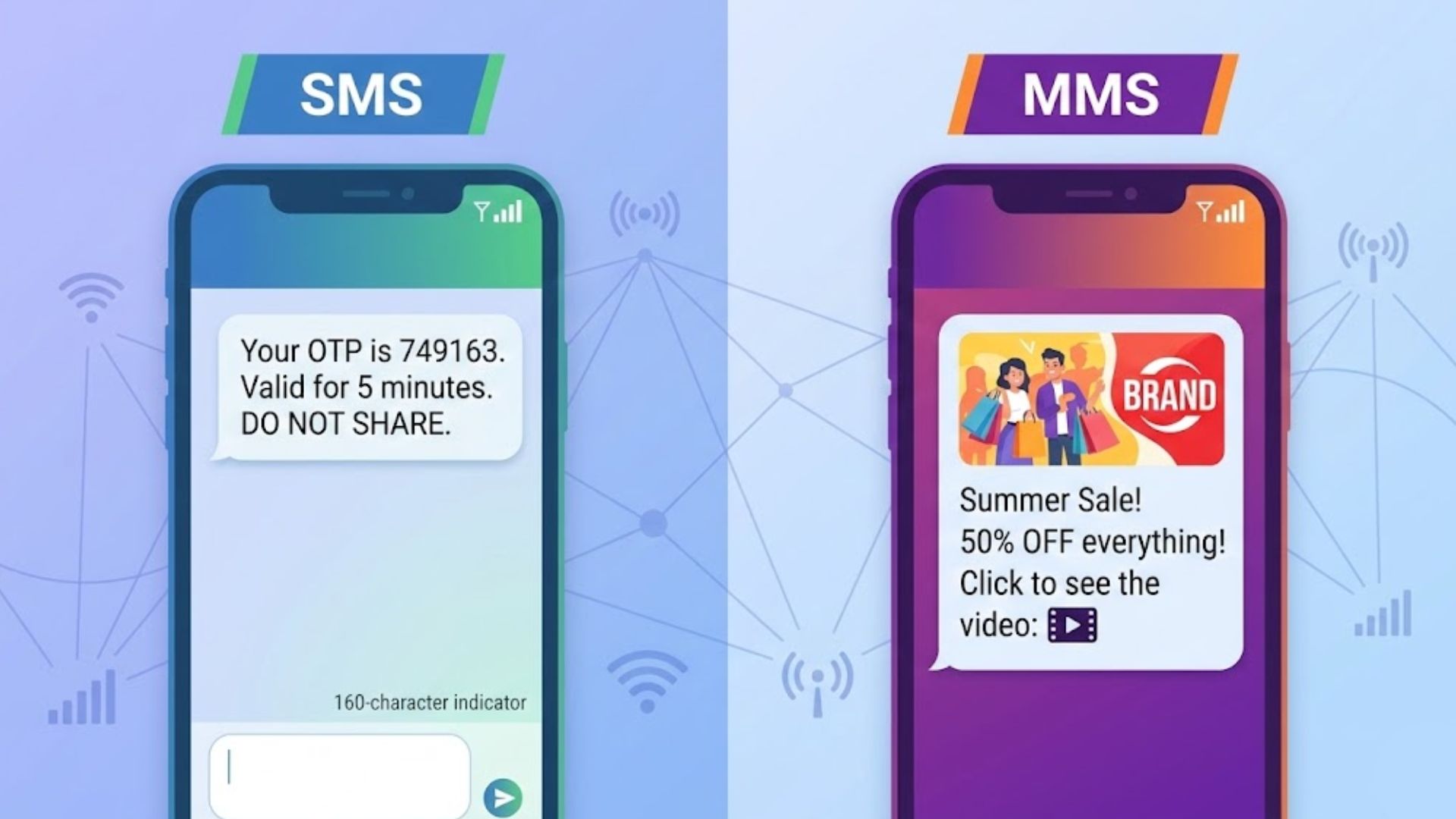
SMS sends short text messages through cellular networks without requiring internet connectivity.
When a message is sent, it travels through a Short Message Service Center (SMSC) operated by mobile carriers. The SMSC temporarily stores the message and forwards it to the recipient’s phone.
Because SMS uses telecom infrastructure rather than internet data, it works even on:
- Basic mobile phones
- Devices without internet access
- Weak network conditions
This reliability explains why SMS is widely used for:
- One-time passwords (OTP)
- banking alerts
- delivery notifications
- appointment reminders
Real-world example: A logistics company sending delivery updates will often use SMS because it guarantees high message delivery even in areas with limited internet access.
How Does MMS Work?
MMS extends SMS by allowing multimedia content such as images, videos, audio, and longer messages.
Instead of sending only text, MMS uploads media files to a carrier server, which then delivers them to the recipient through mobile data or cellular networks.
Common MMS content includes:
- product images
- promotional banners
- event invitations
- animated marketing messages
Because MMS supports media, it often creates higher engagement in marketing campaigns, particularly when visual elements matter.
Example scenario: A restaurant promoting a seasonal menu might send an MMS with a photo of the dish and a short promotional message.
When Should SMS Be Used Instead of MMS?
SMS works best for short, time-sensitive communication where reliability matters more than visual content.
Businesses commonly use SMS in situations such as:
- security verification codes
- order confirmations
- banking alerts
- appointment reminders
- service updates
Note: Security-sensitive services such as banking, fintech platforms, and online marketplaces frequently rely on OTP SMS verification systems to confirm user identities during login or transactions.
Why SMS is still widely used
Advantage | Explanation |
High reliability | Works even without internet |
Fast delivery | Messages usually arrive within seconds |
Lower cost | Cheaper than MMS for large volumes |
Universal compatibility | Works on nearly all mobile phones |
Many companies prioritise SMS when speed and reach are more important than visual presentation.
Businesses running promotional campaigns often combine MMS visuals with targeted text campaigns through SMS marketing to reach customers quickly and reliably.
When is MMS a Better Option?
MMS is ideal when communication benefits from images, videos, or branding elements.
Marketing campaigns frequently rely on MMS because visuals can increase attention and engagement.
Typical MMS use cases include:
- product launches
- promotional campaigns
- digital coupons
- event invitations
- branded announcements
Example marketing scenario: A retail store launching a festive sale may send an MMS message showing product images and a promotional banner.
This visual format can often generate higher click-through or response rates compared to plain text messages.
Read more: How Retail and eCommerce Brands Use Bulk SMS
Is SMS or MMS More Reliable?
SMS is generally more reliable than MMS because it uses simpler telecom infrastructure.
SMS messages require minimal bandwidth and are supported by nearly all mobile networks. MMS messages depend on additional media handling and data connectivity.
In environments with weaker connectivity, SMS usually performs better.
Factor | SMS | MMS |
Delivery reliability | Very high | Moderate |
Network requirements | Cellular signal only | Cellular + data |
Failure risk | Low | Slightly higher |
For this reason, critical notifications such as security alerts or system updates typically use SMS instead of MMS.
Which One is Better for Business Communication?
Neither MMS nor SMS is universally better; the right choice depends on communication goals.
Businesses often use both messaging formats as part of a broader communication strategy.
Communication Goal | Recommended Format |
Security verification | SMS |
Transaction alerts | SMS |
Marketing promotions | MMS |
Product announcements | MMS |
Customer service updates | SMS |
Many communication platforms allow businesses to combine SMS and MMS campaigns, using SMS for reliability and MMS for visual engagement.
Why Understanding MMS vs SMS Matters for Modern Messaging
Mobile messaging continues to play an important role in digital communication. While messaging apps dominate social conversations, SMS and MMS still power many critical business interactions.
Telecommunications analysts often highlight that SMS remains one of the most reliable communication channels, while MMS expands messaging capabilities into richer visual formats.
Understanding the difference between MMS vs SMS helps businesses choose the right format depending on whether the priority is:
- speed
- reach
- cost
- visual impact
Using the correct messaging format can improve customer experience while ensuring communication remains clear and effective.
Conclusion
SMS and MMS serve different but complementary purposes in modern messaging.
SMS prioritises reliability, speed, and universal compatibility, making it ideal for alerts, verification codes, and important updates. MMS focuses on multimedia communication, allowing businesses and organisations to deliver visually engaging messages.
For many communication strategies, the best approach is not choosing one over the other, but using both formats strategically depending on the message type.
When speed and reach matter most, SMS remains the preferred option. When visual storytelling is important, MMS provides the flexibility to deliver richer communication experiences.
Businesses exploring reliable messaging infrastructure can learn more about SMS service Malaysia providers that support bulk messaging, OTP verification, and marketing campaigns.