

Key Takeaways
- Choose eSIM for digital activation, travel convenience and managing multiple mobile plans.
- Choose a physical SIM if you regularly move your number between phones or use older devices.
- Both formats can support calls, mobile data, SMS and OTP codes when included in the mobile plan.
- eSIM does not automatically provide better coverage, speed or signal strength.
- Many modern phones let you use an eSIM and physical SIM together.
You are most likely comparing eSIM and physical SIM because you are buying a new phone, changing mobile providers, preparing to travel or deciding whether to convert your existing SIM.
For most users, eSIM is more convenient, especially for travel and digital activation. However, a physical SIM is easier to move between phones and remains compatible with more devices.
The right choice depends on what you need to do with your mobile number.
Should You Choose eSIM or a Physical SIM?
Use this quick guide before looking at the technical differences.
Your Situation | Better Starting Choice |
You are travelling overseas | eSIM |
You frequently change phones | Physical SIM |
You want to activate a plan online | eSIM |
You use an older phone | Physical SIM |
You need personal and work numbers | eSIM or dual SIM |
You keep an emergency backup phone | Physical SIM |
You want a temporary data plan | eSIM |
Your provider does not support eSIM | Physical SIM |
You are worried about losing a SIM card | eSIM |
You want the simplest possible phone transfer | Physical SIM |
Neither option is universally better. The decision becomes easier once you know why you need the SIM and how you normally use your phone.
When to Choose eSIM vs. Physical SIM
Most users compare these formats when buying a new phone, traveling, or changing providers. Use this guide to decide which fits your lifestyle:
- Choose eSIM if: You travel frequently (easy digital activation of data plans), want to manage multiple lines on one device (Dual-SIM), or prefer the convenience of setting up a plan without visiting a store.
- Choose a Physical SIM if: You frequently swap your number between different phones, rely on older legacy devices, or keep a basic backup phone for emergencies.
- The “Best of Both” Approach: Most modern smartphones are “Dual-SIM” capable, allowing you to run one physical SIM and one eSIM simultaneously. This is the ideal setup for keeping a primary local number (Physical) while using a cost-effective data plan when traveling (eSIM).
eSIM vs Physical SIM at a Glance
Factor | eSIM | Physical SIM |
Format | Built into the device | Removable card |
Activation | Completed digitally | Card is inserted into the phone |
Device compatibility | Requires a supported device | Works with most phones that have a SIM tray |
Changing phones | May require transfer or provider support | Usually moved manually |
Travel plans | Easy to add digitally | Requires another physical card |
Multiple plans | Several profiles may be stored | Limited by available SIM slots |
Risk of physical loss | Cannot be misplaced separately | Can be lost or damaged |
Calls and SMSC | Supported when included in the plan | Supported when included in the plan |
| Network signal | Depends on provider and device | Depends on provider and device |
Best suited to | Travel, digital activation and multiple plans | Easy transfers and broad compatibility |
What is an eSIM Card?
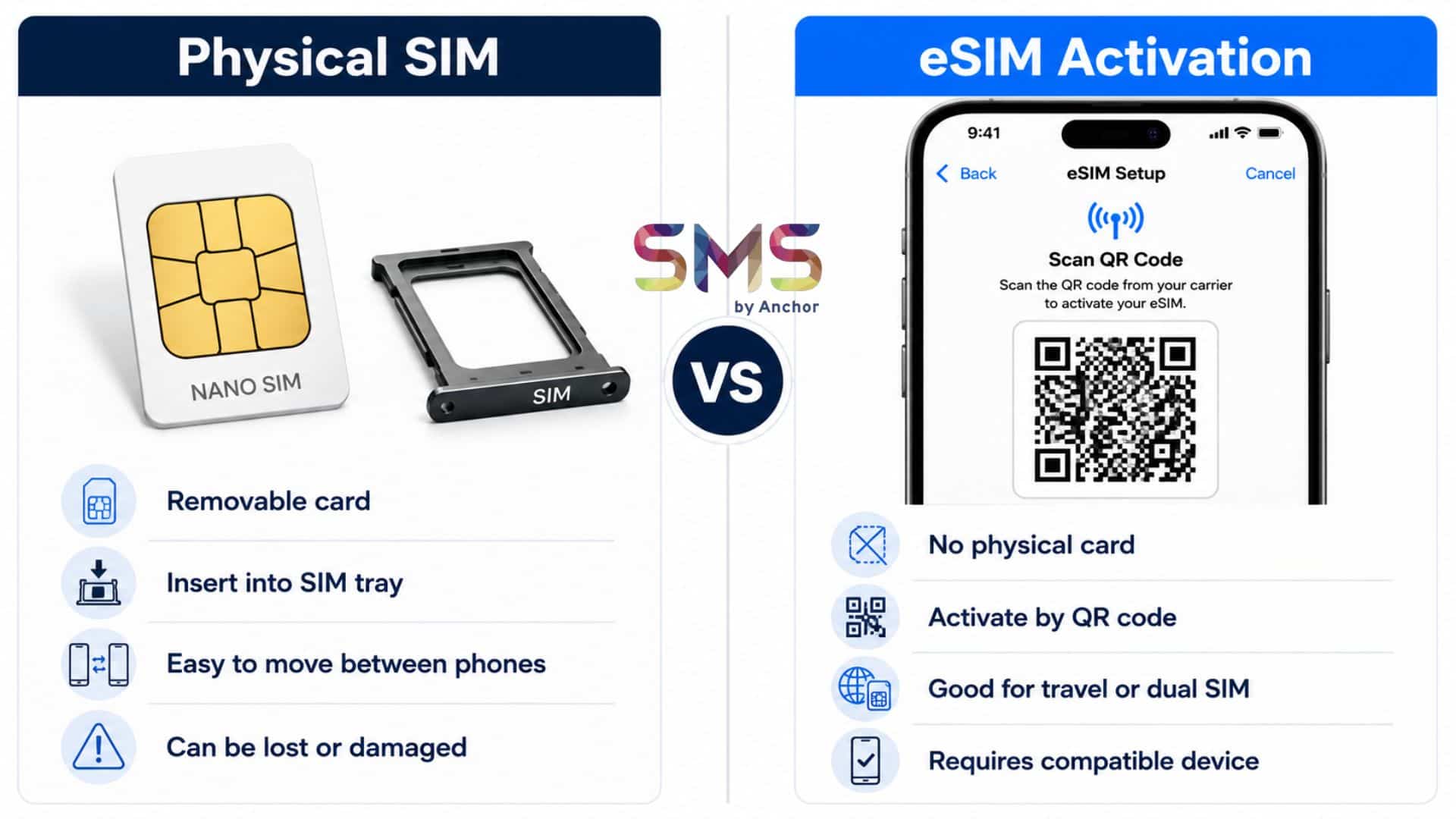
An eSIM, or embedded SIM, is a digital, programmable chip built directly into a smartphone or device motherboard, replacing the need for a removable plastic SIM card.
Despite the common phrase “eSIM card,” there is no separate card to insert. The SIM technology is already embedded in the device, and the mobile plan is activated digitally.
Activation may involve:
- Scanning a QR code
- Using the provider’s mobile application
- Following instructions in the device settings
- Transferring an eSIM from another phone
- Requesting activation from the provider
Once activated, an eSIM works much like a physical SIM. Depending on the plan, it can support calls, SMS, OTP codes, roaming and mobile data.
What is a Physical SIM Card?
A physical SIM is a removable card that identifies your mobile subscription to the network.
Most modern phones with SIM trays use nano-SIM cards. You insert the card into the phone and activate it through the mobile provider.
Its main advantage is portability. When changing compatible phones, you can often move the SIM card directly without downloading a new profile.
However, a physical SIM can be removed, misplaced or damaged.
Is eSIM Better Than a Physical SIM?
eSIM is better for convenience, while a physical SIM is often better for simple device transfers.
Choose eSIM If:
- You travel frequently.
- You want to activate a plan online.
- You want personal and business numbers on one phone.
- You use temporary overseas data plans.
- You prefer not to handle a small SIM card.
- You own a compatible smartwatch or tablet.
- You want to store several mobile profiles.
Choose a Physical SIM If:
- You frequently move your number between phones.
- You use an older or lower-cost device.
- You keep a basic backup phone.
- Your provider has limited eSIM support.
- You prefer manual setup.
- You may need to change devices without internet access.
- You do not want to depend on a digital transfer process.
For many people, the best arrangement is not one format or the other. It is using both through a dual-SIM phone.
Is eSIM Available in Malaysia?
Yes. Several Malaysian mobile providers offer eSIM plans or let eligible customers convert an existing physical SIM to eSIM.
Availability may depend on:
- The mobile provider
- The selected plan
- The phone model
- Where the device was purchased
- Whether the number is prepaid or postpaid
- The provider’s registration process
Before converting, confirm that both the device and mobile plan support eSIM. Do not assume that every eSIM-compatible phone works with every Malaysian provider.
Can eSIM Receive SMS and OTP Codes?
Yes. An active eSIM can receive SMS and OTP codes like a physical SIM, provided the mobile plan supports SMS and the number is connected to the network.
The sender normally sends the message to your mobile number. It does not need to know whether that number is connected through an eSIM or physical SIM.
Both formats can receive:
- Banking OTP codes
- Login verification codes
- Payment alerts
- Delivery notifications
- Appointment reminders
- Account updates
- Promotional messages
SMS delivery can still be affected by poor coverage, roaming restrictions, an inactive plan, incorrect phone numbers, device settings or provider filtering.
For businesses, this means the growth of eSIM does not require a separate messaging campaign. A reliable SMS service provider can continue sending OTP codes, alerts and bulk messages to both eSIM and physical SIM users through the same SMS gateway or API.
Common Questions: Performance, Security, and Compatibility
- Network Quality: eSIMs do not provide better signal or speed than physical SIMs. Performance is determined entirely by your mobile provider, network coverage, and your phone’s hardware (bands/5G support).
- Security: eSIMs offer a slight physical security advantage because they cannot be removed from a stolen device. However, you must still secure your account with strong PINs and 2FA, as both formats are equally vulnerable to SIM-swap fraud.
- Travel Convenience: eSIMs allow you to pre-install data plans before landing. Important: Before purchasing a travel eSIM, ensure your phone is network-unlocked. If your device was purchased via a local telco contract, it may be locked to that provider, preventing you from adding third-party eSIMs until the contract is cleared.
- SMS & OTPs: Both formats receive SMS and bank OTPs identically, provided your plan supports messaging. Businesses can continue using existing SMS gateways for both eSIM and physical SIM users.
Important: Before purchasing a travel eSIM, ensure your phone is network-unlocked. If your device was purchased via a local telco contract, it may be locked to that provider, preventing you from adding third-party eSIMs until the contract is cleared.
Can You Use eSIM and Physical SIM Together?
Yes. Many modern phones support both an eSIM and a physical SIM at the same time.
This can be useful when you want to:
- Separate personal and business numbers
- Keep a Malaysian number while travelling
- Use one provider for calls and another for data
- Maintain a backup network
- Receive OTP codes on one line
- Use a temporary data plan on another line
Check how many lines your device can keep active simultaneously. Some phones can store several eSIM profiles but only allow one or two active lines at a time.
Is It Difficult to Change Phones With an eSIM?
It can be slightly more complicated than moving a physical SIM, although modern phones and providers increasingly support digital transfers.
An eSIM transfer may involve:
- Placing the old and new phones near each other.
- Starting a transfer through the device settings.
- Verifying the mobile account.
- Downloading the eSIM profile.
- Testing calls, SMS and mobile data.
- Removing the profile from the old phone.
In some cases, the provider may issue a new QR code or require identity verification.
A physical SIM is usually simpler during an emergency phone change because the user can move the card manually.
Can You Convert a Physical SIM to eSIM?
Many providers allow eligible users to convert an existing physical SIM to an eSIM.
A typical process includes:
- Confirming that the phone supports eSIM.
- Requesting a conversion from the provider.
- Completing account or identity verification.
- Downloading the eSIM profile.
- Checking calls, SMS and mobile data.
- Removing the inactive physical SIM.
The physical card usually stops working after the conversion is completed.
Before converting, consider whether you regularly use backup phones. Returning to a physical SIM later may require another provider request or SIM replacement.
Does eSIM Work Without Internet?
An internet connection is normally required to download and activate an eSIM profile.
Once activated, the eSIM uses the mobile network like a physical SIM. You do not need a permanent Wi-Fi connection just because the phone uses eSIM.
In simple terms:
- Internet may be required for initial activation.
- Calls use the mobile network.
- SMS uses the mobile network.
- Mobile data uses the activated plan.
- A deleted profile may require internet access to reinstall.
What Happens If You Lose a Phone With an eSIM?
Contact the mobile provider and ask it to suspend or transfer the mobile line.
Because the eSIM cannot be removed physically, the line may remain connected to the lost device until it is disabled. This can potentially help with device-location services, but it also means the account should be secured quickly.
You should:
- Mark the device as lost.
- Change important account passwords.
- Contact the mobile provider.
- Suspend or transfer the number.
- Review banking and account activity.
- Avoid giving OTP codes to anyone claiming to help recover the phone.
What Happens If You Delete an eSIM?
Deleting an eSIM removes the mobile profile from the device. It does not necessarily cancel the mobile plan or terminate the account.
To use the number again, you may need to:
- Reinstall the profile
- Scan a new QR code
- Use the provider application
- Contact customer support
- Complete identity verification
Do not delete an eSIM as a general troubleshooting step unless you understand the provider’s reactivation process.
Conclusion
eSIM and physical SIM cards connect devices to mobile networks in different ways, but both can support calls, mobile data and SMS. eSIM offers convenient digital activation and easier management of multiple plans, while physical SIM cards remain widely compatible and simple to move between devices.
For businesses, the rise of eSIM does not remove the role of SMS. OTP codes, alerts and transactional notifications can still be sent to customers regardless of which SIM format they use. SMS by Anchor helps businesses manage bulk SMS, OTP delivery and API-based notifications through a locally focused messaging platform.