

Key Takeaways
- SMS advertising delivers some of the highest open rates, often above 90%, when timing and relevance are aligned
- Strong hooks in the first 6–8 words determine whether users click or ignore your message
- Personalisation and segmentation outperform generic bulk blasts by a wide margin
- Clear CTAs with urgency, such as limited-time offers, significantly improve click-through rates
- Compliance, opt-ins, and timing are critical to avoid spam flags and maintain deliverability
Most marketing channels fight for attention. SMS skips the fight entirely and lands directly in the inbox people actually check.
Yet many campaigns still underperform. Messages get opened, but not clicked. That gap between visibility and action is where most revenue is lost.
In this guide, we break down what actually drives high CTR in SMS advertising, from hook formulas to timing strategies, so your campaigns do not just reach people, they convert.
What Drives High CTR in SMS Advertising?
High CTR in SMS advertising comes from three key factors: a strong opening hook, precise targeting, and a clear, time-sensitive CTA. Messages that feel personal, relevant, and urgent consistently outperform generic promotions.
SMS Advertising Performance Comparison
Factor | Low CTR Campaign | High CTR Campaign | Impact |
Opening line | Generic promo | Curiosity-driven hook | +30–60% CTR |
Targeting | Mass send | Segmented audience | +2–3x engagement |
CTA | Vague | Clear + urgency | +40% clicks |
Timing | Random | Behaviour-based | Higher conversions |
Personalisation | None | Name + context | Stronger response |
How Does SMS Advertising Actually Work?
SMS advertising delivers short, direct messages to opted-in users, designed to trigger immediate action.
Unlike email or social media, SMS does not rely on algorithms. Delivery is near-instant, and visibility is almost guaranteed.
Businesses typically use tools like bulk SMS platforms, OTP notifications, or promotional campaigns to engage users at different stages of the journey.
A typical flow looks like this:
- User opts in (checkout, signup, promo)
- Message is triggered (campaign or automation)
- User reads within minutes
- CTA drives action (click, reply, purchase)
“SMS remains one of the most direct and measurable communication channels, especially for time-sensitive campaigns.”
Why is SMS Advertising CTR So High Compared to Other Channels?
SMS advertising benefits from immediacy and low competition in the inbox.
People receive far fewer SMS messages than emails or ads. This makes each message more noticeable and less likely to be ignored.
There is also a behavioural factor. SMS is often associated with urgency, such as banking alerts or OTP verification, so users are conditioned to open messages quickly.
Real-world scenario:
A retail brand sends an email campaign and an SMS campaign for the same promotion.
- Email CTR: 2–5%
- SMS CTR: 15–35%
That difference often determines whether a campaign is profitable or forgettable.
Read more: 7 Reasons SMS Marketing is the Highest ROI Tool in Your Tech Stack
What Makes an SMS “Clickbait” Hook Work Without Feeling Spammy?
The best SMS hooks create curiosity or urgency without misleading the reader.
High-performing hooks typically fall into a few categories:
1. Curiosity-Based Hooks
- “This deal ends sooner than you think…”
- “You were selected for something exclusive…”
2. Urgency Hooks
- “Only 3 hours left to claim this”
- “Last chance before midnight”
3. Personalised Hooks
- “Your reward is ready, don’t miss it”
- “We saved this just for you”
4. Benefit-Driven Hooks
- “Save RM50 on your next order today”
- “Get faster checkout with this steps”
What to avoid:
- Overpromising or misleading claims
- ALL CAPS spam-style messaging
- Excessive emojis or symbols
How Important is Timing in SMS Advertising?
Timing can make or break your CTR, even with a strong message.
Sending at the wrong moment reduces engagement and may violate MCMC SMS regulations, regardless of how compelling your copy is.
Best-performing time windows (general trends)
- Mid-morning (10am–12pm): Users are active and responsive
- Evening (6pm–9pm): Post-work browsing and shopping
- Event-based timing: Flash sales, payday, weekends
Timing mistakes to avoid
- Late-night sends (high opt-out risk)
- Over-sending (message fatigue)
- Ignoring user behaviour patterns
Practical example: An eCommerce campaign timed during lunch hours often outperforms the same message sent early morning.
Does Personalisation Really Improve SMS CTR?
Yes, and often dramatically. Personalised SMS campaigns consistently outperform generic ones.
Personalisation goes beyond just inserting a name. It includes:
- Purchase history
- Location relevance
- Behavioural triggers
Example comparison
Message Type | CTR |
Generic promo | 8–12% |
Personalised offer | 20–35% |
Real-life use case:
A customer who abandoned a cart receives a reminder via a targeted SMS marketing message with a discount code. This often converts better than a generic promotion.
What Role Does CTA Play in SMS Advertising Success?
A strong CTA tells users exactly what to do next, without confusion.
High-performing CTAs:
- Are specific (“Claim your RM20 voucher”)
- Include urgency (“Ends tonight”)
- Use action verbs (“Get”, “Unlock”, “Reserve”)
Weak vs Strong CTA
- Weak: “Check this out”
- Strong: “Shop now and save RM30 today”
Tip: Keep context short and clear. SMS users decide quickly, so friction must be minimal.
How Do Different SMS Use Cases Affect CTR?
Different SMS types serve different goals, and CTR varies accordingly.
SMS Type | Purpose | Typical CTR |
OTP SMS | Verification | Very high engagement |
Promotional SMS | Sales | Moderate to high |
Transactional SMS | Updates | High trust, moderate CTR |
Reminder SMS | Retention | Strong repeat engagement |
Businesses often combine:
- OTP SMS for trust and verification
- SMS blasting campaigns for promotions
- Bulk SMS campaigns for scale
This creates a full-funnel communication strategy.
Common Mistakes That Kill SMS CTR
Even strong campaigns fail due to avoidable mistakes.
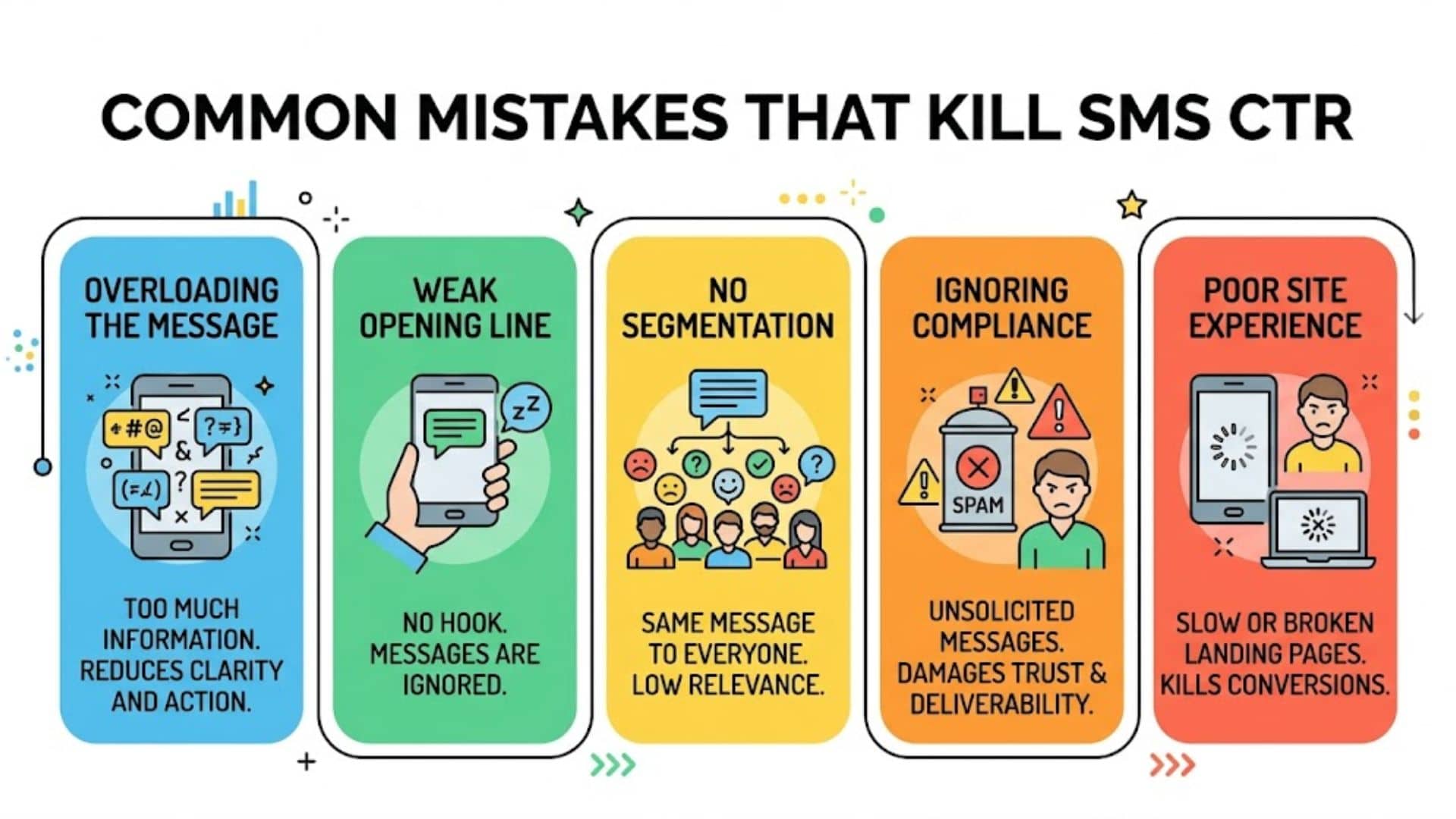
1. Overloading the message
Too much information reduces clarity and action.
2. Weak opening line
If the first line does not hook attention, the message is ignored.
3. No segmentation
Sending the same message to everyone reduces relevance.
4. Ignoring compliance
Unsolicited messages damage trust and deliverability.
5. Poor site experience
When users read the messages and search on the web, getting slow or broken landing pages kill conversions.
SMS Advertising Strategies That Actually Improve CTR
Mastering your hooks is just the beginning. As we move into 2026, the technology behind the message is shifting. Learn how to stay ahead of the curve by understanding the latest shifts in SMS advertising and verification, including the move from green to blue ticks.
High CTR SMS advertising comes down to relevance, timing, and clarity.
Focus on:
- Short, compelling hooks
- Clear and urgent CTAs
- Behaviour-driven targeting
- Consistent testing and optimisation
The difference between average and high-performing campaigns is often just a few strategic tweaks.
If you are exploring ways to improve engagement through structured campaigns such as bulk messaging solutions or targeted SMS campaigns on reliable SMS service providers, aligning your messaging strategy with user behaviour is where the real gains happen.