

Key Takeaways
- Structural Blueprint: A data model defines exactly how business information connects, stores, and functions across different software systems.
- Operational Efficiency: Strategic data modelling prevents expensive database errors, eliminates internal communication silos, and ensures highly accurate business reporting.
- Three-Stage Framework: The process moves systematically from high-level business concepts down to the actual technical design of backend databases.
- Scalable Infrastructure: Clean data design allows growing businesses to adopt automated marketing tools and customer tracking systems without crashing.
- Long-Term Savings: Mapping out your information early prevents hours of manual work spent cleaning up messy spreadsheets and duplicate customer profiles.
Running a growing business on disconnected systems is like trying to manage a busy regional warehouse using nothing but random sticky notes. It might work when you are tracking ten items, but the moment your customer database and transaction volumes expand, the entire system collapses under its own weight.
To answer what is data model in the simplest terms: it is a visual blueprint or framework that standardises and defines how different pieces of business information relate to one another. Much like an architectural drawing guides builders, structured data modelling ensures your software systems, point-of-sale terminals, and big data platforms talk to each other without errors. This guide breaks down how organising your information layout turns confusing operational metrics into a clear path toward business growth.
Modelling Stage | Best For | Key Focus | Business Value |
Conceptual Model | Business owners and stakeholders | High-level business rules and concepts | Aligns company goals with digital strategy. |
Logical Model | Project managers and analysts | Data structures, columns, and relationships | Creates a clear map of information flow. |
Physical Model | Database developers and IT teams | Actual database code, storage, and hardware | Builds the actual system to run operations. |
Why is Data Modelling Essential for Growing Modern Businesses?
Structuring your information prevents internal system blind spots and protects your long-term profit margins.
When your business data is unorganised, different departments end up operating in total isolation. Your sales team might track customer phone numbers one way, while your billing department tracks them using an entirely different format. This mismatch results in missing invoices, lost customer records, and frustrated staff members who must manually fix errors.
By implementing a consistent design process across your organisation, you create a single source of truth. Every department accesses the same verified pool of information, allowing your team to move quickly, accurately evaluate your sms marketing roi, and make strategic decisions based on hard facts rather than guesswork.
The Cost of Disorganisation: According to industry research, businesses lose up to 20% of their operational productivity dealing with poor data quality and system mismatches. Fixing structural errors during the planning stage is up to 10 times cheaper than rewriting code after a database goes live.
What is a Data Model and How Does It Actually Work?
A proper model maps real-world business actions directly into clean, searchable digital structures.
To build a reliable structure, analysts look at your daily business operations and break them down into “entities” and “attributes.” For example, a retail business has entities like Customers, Orders, and Products. The attributes are the specifics, like a customer’s phone number, an order date, or a product’s price.
The magic happens when you define the relationships between these pieces. The system needs to know that One Customer can place Many Orders, but Each Order connects back to One Specific Customer. Defining these rules keeps your data clean, organised, and lightning-fast to search.
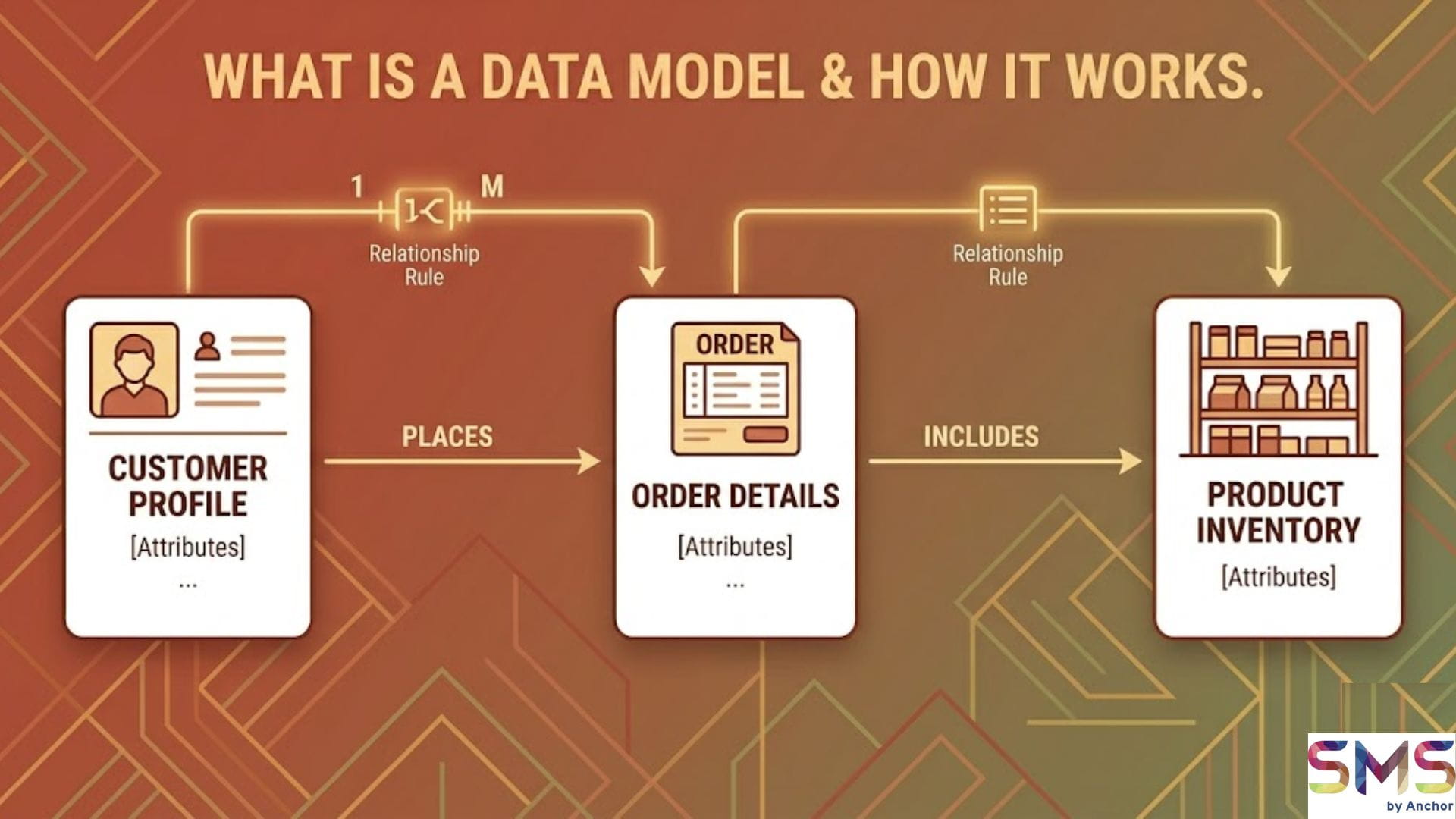
[Customer Profile] ➔ Places ➔ [Order Details] ➔ Includes ➔ [Product Inventory]
How Do Different Types of Data Models Prevent Operational Chaos?
Moving systematically through structural stages ensures that your business goals match your IT infrastructure perfectly.
You do not build a physical database overnight; you build it in stages to ensure nothing gets missed. The journey starts with a high-level conceptual layout to agree on what needs tracking, moves into a logical layout to map the exact details, and finishes with a physical layout built for your specific software.
This staged approach keeps your tech team from building systems that do not match how your business actually runs. It ensures that your customer data platforms are ready to integrate with tools built for sms marketing or inventory tracking programs, without needing a total system overhaul.
“A database built without a clear structural model is simply an expensive digital junk drawer. You can throw information into it, but finding what you need to close a sale or ship an order becomes a challenge.”— SMS Anchor
What Are the Most Common Mistakes Businesses Make with Data Modelling?
Failing to plan for future scale or ignoring real-world user habits will quickly ruin even the most expensive database setup.
The most frequent mistake growing brands make is designing a system that is too rigid. Market conditions shift rapidly, and if your data structure cannot handle new information types, such as managing opt-out preferences during high-volume sms blasting, your system becomes obsolete within a year., your system becomes obsolete within a year.
Another common pitfall is forgetting about the people who will actually use the system daily. If your input rules are too complex, your staff will find shortcuts or stop entering data entirely, leaving you with incomplete records that hamper your analytics.
- Over-complicating the Design: Creating hundreds of unnecessary data fields that your team will never actually use.
- Ignoring Data Standards: Letting different software programs use varying formats for basic info like dates and phone numbers.
- Skipping the Testing Phase: Launching a live database without checking if it slows down during peak customer transaction hours.
Mastering Your Data Model to Build a Scalable Business
Taking the time to map out a clear database structure ensures your business is built on a foundation that can scale. When your systems are organised properly, expanding into new digital channels, tracking inventory across multiple locations, and launching targeted marketing programs becomes completely seamless.
With a solid data framework in place, you can confidently connect your clean customer databases to a reliable sms gateway. This allows you to deploy instant transactional notifications, order updates, and marketing alerts that keep your operations running smoothly and your customers engaged.