
Key Takeaways
- The Core Distinction: SMS (Short Message Service) is primarily a text messaging protocol traditionally limited to 160 GSM-encoded characters before messages are segmented into multiple parts. RCS (Rich Communication Services), by contrast, uses internet protocol (IP) networks to deliver app-like messaging experiences directly inside a phone’s native messaging inbox.
- The Reach Variable: While SMS offers the broadest global reach across virtually all mobile devices, recent ecosystem updates, including Apple’s support for RCS in iOS 18 have significantly expanded RCS availability across both Android and iPhone users.
- Strategic Next Step: Businesses should deploy a hybrid infrastructure where RCS is used as the primary channel to deliver highly interactive, verified brand experiences, with an automated fallback to SMS ensuring delivery to legacy devices.
Choosing the right mobile messaging gateway is no longer a simple matter of broadcasting plain-text notifications. When comparing RCS vs SMS, businesses must weigh the universal reach of traditional text messaging against the rich, verified, interactive capabilities of modern communication suites. To maximise customer engagement, companies must understand exactly when to leverage the rock-solid reliability of a traditional text and when to employ the app-like immersion of rich communication.
Decoding the Protocols: What is the Difference Between SMS and RCS?
To effectively evaluate sms vs rcs, it helps to look at the underlying technology. SMS relies on the signaling pathways of cellular networks; it is lightweight, fast, and works on literally any mobile phone with a cellular signal. RCS, on the other hand, operates over data networks (cellular data or Wi-Fi). It turns the native text messaging application into an interactive platform capable of handling high-resolution media, structured cards, and live conversational chatbots without forcing the user to download an external application.
The core technical and functional capabilities diverge significantly across several parameters:
Capability / Feature | SMS (Short Message Service) | RCS (Rich Communication Services) |
Character Limit | Strict 160-character block limit | Virtually unlimited text capacity |
Media Support | Text only (MMS allows low-res compressed media) | High-resolution images, video, PDFs, audio |
Sender Identification | Numeric shortcodes or unverified long numbers | Verified Business Profile with brand logo and colours |
User Interactivity | Static text replies only | Quick-reply chips, calendar links, carousel cards |
Engagement Tracking | Delivery receipts only | Real-time read receipts and typing indicators |
Network Dependency | Standard cellular network coverage | Wi-Fi or mobile data network connection |
The Performance Reality Check: Data from the Field
For years, the SMS vs RCS debate was heavily influenced by the lack of native RCS support on Apple devices. That changed with Apple’s introduction of RCS support in iOS 18, although availability still depends on carrier support and regional rollout.
Industry adoption of RCS has accelerated significantly due to broader carrier deployment, richer brand messaging capabilities, and increased cross-platform compatibility.
During recent client pilots, we evaluated the performance differences between these two channels by splitting an identical promotional audience into two distinct groups.
Group A received a standard, optimised SMS message featuring a short path. Group B received a verified RCS business message displaying a rich carousel layout that allowed customers to scroll through product images and tap native “Buy Now” chips directly within the message window.
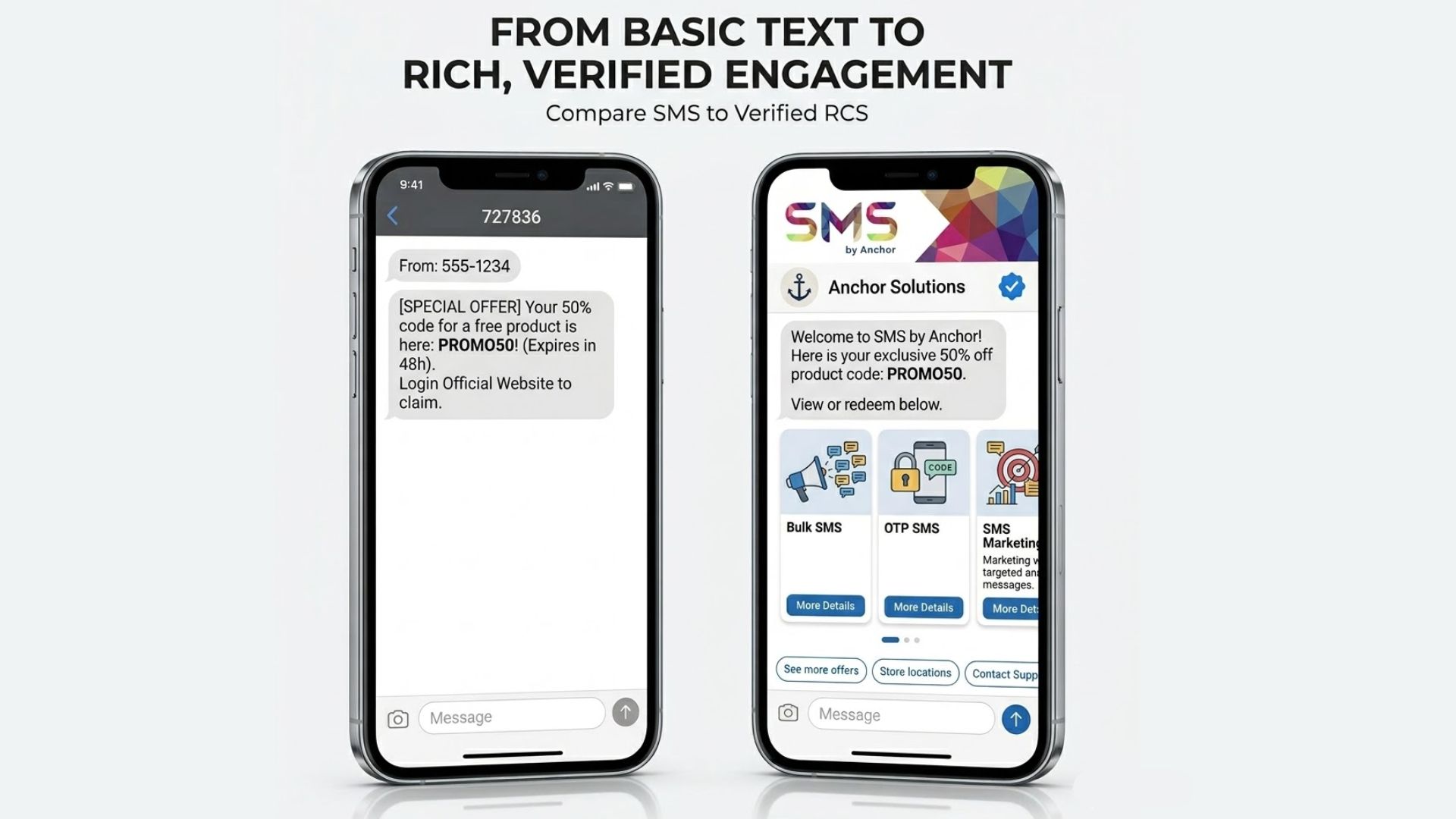
Our internal pilot campaigns revealed a substantial difference in customer engagement between standard SMS and branded RCS experiences. While traditional SMS maintained exceptionally strong open rates, RCS campaigns generated significantly higher interaction rates thanks to rich media, interactive buttons, and verified business branding.
Additionally, verified sender profiles displaying official logos and business names appeared to improve customer trust and reduce opt-out behaviour compared to traditional SMS messages sent from generic shortcodes.
The visual trust indicators inherently mitigated the consumer skepticism often associated with text messages sent from random, unverified 5- or 6-digit shortcodes.
RCS vs SMS: Balancing Rich Features and Universal Reach
When engineering a modern mobile communication stack, both channels offer distinct operational advantages and limitations.
Why SMS Remains Essential
- Universal Ubiquity: SMS requires no data connection, no specific operating system version, and no carrier compatibility updates. It works everywhere, instantly.
- Perfect for Critical Alerts: Because it doesn’t rely on data networks, SMS remains the gold standard for time-sensitive, mission-critical communications like two-factor authentication (2FA) codes, emergency alerts, and immediate transactional notifications.
Where RCS Dominates
- App-Like Conversion Funnels: RCS allows users to select flight seats, book appointments, change delivery times, or complete a purchase using native, interactive buttons without ever leaving their text app. This reduction in friction can significantly improve customer engagement and streamline conversion journeys.
- Enhanced Security and Trust: Because the onboarding process for RCS Business Messaging requires brand verification, it significantly reduces the risk of spoofing and phishing compared to traditional SMS, while improving customer trust through verified sender identities.
How to Implement a Modern SMS vs RCS Hybrid Strategy
You do not have to choose one channel over the other. The most effective mobile marketing architectures integrate both protocols into an automated, dynamic workflow.
Step 1: Set RCS as Your Primary Initiator
Design your rich marketing sequences, conversational customer service chatbots, and interactive product showcases using the RCS framework. This ensures that the vast majority of your modern mobile audience receives the most engaging, high-trust, and visually compelling version of your message.
Step 2: Establish an Automatic SMS Fallback Trigger
Configure your messaging gateway to monitor delivery statuses in real time. If the recipient’s device does not support RCS, lacks a data connection, or belongs to a carrier without active RCS routing, the gateway should automatically deliver a simplified SMS fallback message.
For regulated markets such as Malaysia, businesses should ensure SMS fallback messages comply with local telecommunications regulations, including restrictions on hyperlinks, callback numbers, and requests for personal information
Step 3: Continuously Refine and Segment
Use the real-time read receipts provided by your RCS dashboard to evaluate exactly when your audience engages with your content. Segment users who actively engage with rich carousels into high-intent groups, and maintain a lightweight SMS stream for customers who prefer minimalist, direct text alerts.
Ready to Upgrade Your Mobile Marketing Infrastructure?
Navigating the shifting terrain of mobile communication requires a partner who understands how to balance technical reliability with high-converting rich media features. Relying purely on legacy SMS blasts means leaving significant customer engagement and revenue on the table.
Let our team build a compliant, deeply integrated mobile messaging engine that utilises the absolute best of both worlds. Contact us today to schedule an architecture audit and launch your next-generation messaging strategy.