
Key Takeaways
- SMS marketing ROI consistently outperforms email and ads due to near-instant delivery and high open rates above 90%
- Conversion cycles are shorter because messages reach users directly without algorithm filtering or inbox competition
- Cost per conversion remains low, especially for time-sensitive promotions and repeat customer engagement
- Automation and segmentation improve ROI by sending relevant messages based on behavior and purchase history
- SMS works best when paired with other channels, acting as a conversion trigger rather than a discovery channel
SMS marketing delivers the highest ROI because it combines immediate visibility, high engagement rates, and low operational cost, making it one of the most efficient conversion tools in any digital stack.
Marketing budgets often get stretched across ads, SEO, and social media. Yet, the channel that consistently drives fast conversions is often the simplest one, SMS. No algorithms, no inbox clutter, no delays.
This guide breaks down exactly why SMS marketing ROI stands out, and how each advantage translates into measurable business impact.
Channel ROI Comparison Table
Channel | Avg Open Rate | Speed to Engagement | Cost per Conversion | Best Use Case | ROI Strength |
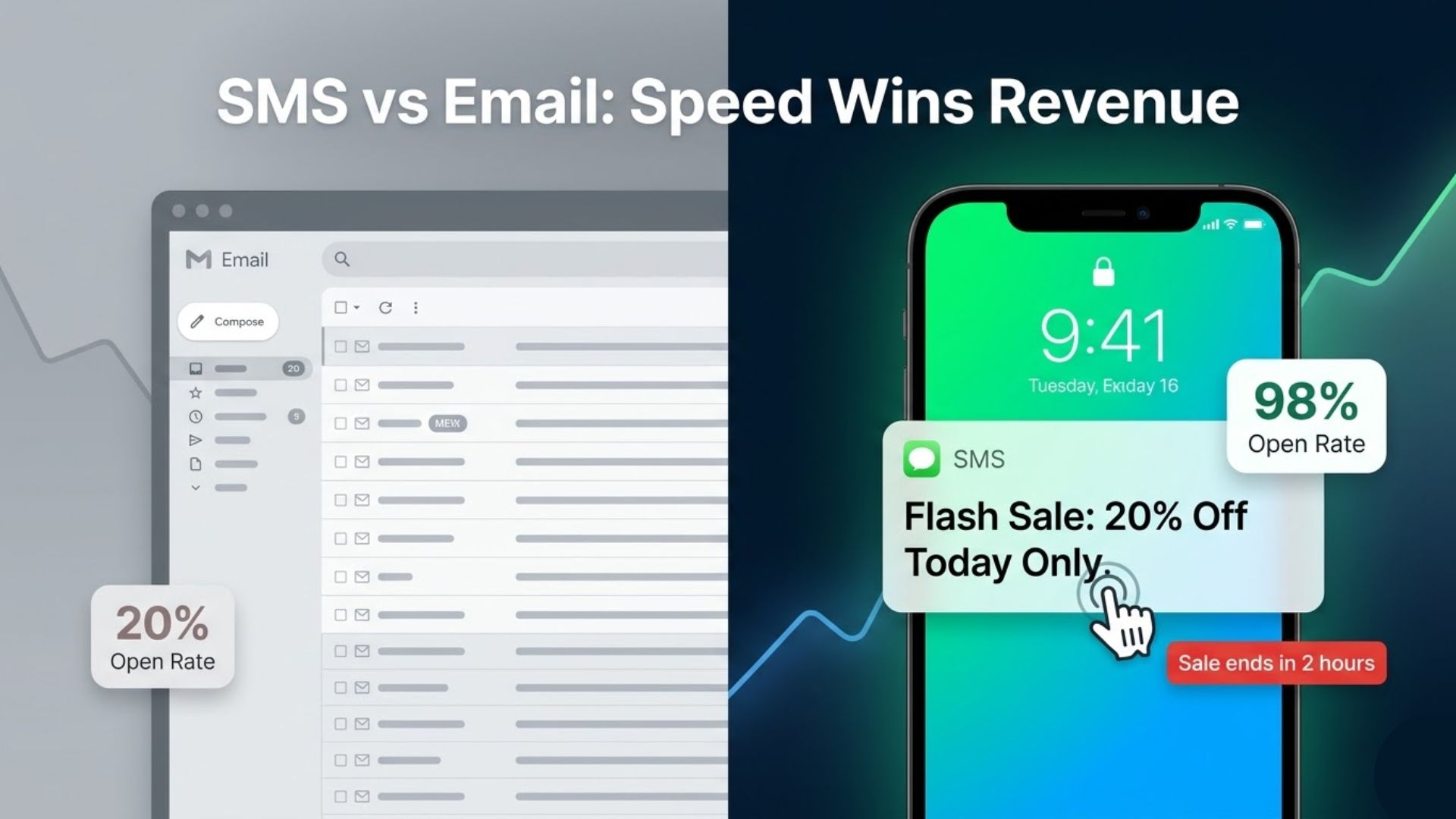
SMS Marketing | 90–98% | Immediate (minutes) | Low | Promotions, reminders, retention | Very High |
Email Marketing | 20–30% | Hours–days | Medium | Newsletters, nurturing | Medium |
Paid Ads | Varies | Immediate | High | Acquisition | Variable |
Social Media | Low–moderate | Delayed | Medium | Awareness | Low–Medium |
Push Notifications | 30–50% | Immediate | Low | App engagement | Medium |
1. Unmatched Open Rates That Drive Immediate Visibility
SMS messages are almost always seen, often within minutes.
Unlike email or social posts, SMS bypasses crowded inboxes and feeds. Most users check messages instantly, making it one of the fastest ways to capture attention.
A typical campaign sees:
- 90%+ open rates
- Most reads within 3–5 minutes
Real-world scenario:
A retail promotion sent via SMS at lunchtime can drive foot traffic the same day, something email campaigns rarely achieve.
“SMS is not just opened, it’s acted on quickly. That’s where ROI compounds.”
2. Faster Conversion Cycles Compared to Email and Ads
SMS shortens the time between message and action.
There’s no need for multiple touchpoints. A clear offer with a clear directions can lead directly to:
- Purchase
- Booking
- Registration
Why this matters for ROI:
- Less nurturing required
- Faster revenue realization
- Reduced dependency on long funnels
Example flow:
- Flash sale SMS sent at 12PM
- Customer acknowledged within minutes
- Purchase the item discounted with the clear instruction given in SMS marketing and completed the purchase by 12:10PM
That compression of time directly increases return on every campaign. You might be wondering if we can include a purchase link in our SMS marketing. Unfortunately, we cannot, due to MCMC SMS regulations.
3. Lower Cost per Conversion
SMS marketing delivers strong results without high spend.
Compared to paid ads where costs fluctuate, SMS pricing remains predictable. When combined with high engagement, the cost per conversion drops significantly.
Typical cost advantages:
- No bidding competition (unlike ads)
- Minimal creative production cost
- High conversion per send
Fact: Even with a smaller contact list, SMS can outperform large-scale ad campaigns in revenue generated per dollar spent.
4. High Engagement Without Algorithm Dependency
SMS eliminates the risk of being hidden by algorithms.
Social media and email platforms decide visibility. SMS does not. Every message lands directly on the user’s device.
Benefits:
- Guaranteed delivery (subject to valid numbers)
- No ranking or filtering issues
- Consistent campaign performance
Use case:
A limited-time offer sent via SMS will reach the entire audience, unlike social posts where only a fraction sees it.
This reliability is a key factor behind strong sms marketing ROI.
5. Personalisation and Segmentation Increase ROI Further
Targeted messages convert better than generic blasts.
Modern SMS platforms allow segmentation based on:
- Purchase history
- Location
- Behavior
- Engagement patterns
Example:
- Repeat customers receive loyalty rewards
- New customers receive onboarding offers
Result:
- Higher click-through rates
- Increased repeat purchases
- Reduced churn
Targeted SMS campaigns often outperform generic campaigns by a wide margin due to relevance.
6. Ideal for Time-Sensitive Campaigns
SMS is the best channel for urgency-driven actions.
Flash sales, appointment reminders, and limited-time deals perform exceptionally well via SMS.
Why it works:
- Immediate delivery
- Instant visibility
- Clear call-to-action
Example scenarios:
- Same-day promotions
- Event reminders
- Payment due alerts
When timing matters, SMS ensures the message is not just delivered but acted upon.
7. Works as a Conversion Layer for Other Channels
SMS amplifies the performance of your entire marketing stack.
Rather than replacing other channels, SMS acts as the final push that converts interest into action.
Integrated strategy example:
- Social media builds awareness
- Email nurtures interest
- SMS triggers conversion
Common combinations:
- Cart abandonment → SMS reminder
- Lead form submission → SMS follow-up
- Promo campaign → SMS last call
This layered approach increases overall ROI across channels, not just SMS alone.
Read more: How SMS Marketing Fits Into Business Communication Strategies
Still deciding if SMS fits your strategy?
If your focus is faster conversions, predictable costs, and direct engagement, SMS is not just another channel, it becomes your highest-performing one.
Why SMS Marketing ROI Continues to Outperform Other Channels
SMS marketing ROI stands out because it combines visibility, speed, and cost efficiency in one channel. While other platforms are useful for awareness and nurturing, SMS excels at converting intent into action.
For businesses focused on measurable results, it remains one of the most practical and scalable tools available today.