

Key Takeaways
- Push notifications are app-based and cost-effective, but require installs and opt-ins
- SMS advertising offers higher open rates and immediate visibility without app dependency
- Push works best for retention, while SMS excels in urgent and transactional messaging
- CTR depends on timing, relevance, and user intent, not just the channel
- A hybrid strategy using both channels often delivers the best overall results
One buzzes silently on your phone screen. The other lands directly in your messages inbox.
Both push notifications and SMS texts aim to grab attention fast, but they work very differently behind the scenes and in performance.
If you are deciding between push notifications and SMS advertising, or figuring out how to use both together, this guide breaks down the real differences that impact engagement, cost, and conversions.
What’s the Difference Between Push Notifications and SMS?
Push notifications are app-based messages sent to users who installed your app and opted in. SMS messages are text messages sent directly to a user’s phone number, requiring no app. SMS offers broader reach and higher visibility, while push notifications are more cost-efficient and suited for app engagement.
Push Notifications vs SMS Comparison Table
Factor | Push Notifications | SMS Advertising |
Delivery method | App-based | Mobile number |
Reach | Limited to app users | Universal (any phone) |
Cost | Low or free per send | Cost per message |
Open rate | Moderate to high | Very high |
Setup | Requires app install | No app needed |
Best use case | Retention | Urgent actions |
How Do Push Notifications Work?
Push notifications are messages sent through mobile apps to users who have installed and enabled notifications.
They appear as pop-ups or banners on the device screen, even when the app is not actively in use.
To use push notifications effectively, businesses need:
- A mobile app
- User opt-in for notifications
- A push notification service
Real-world scenario: An eCommerce app sends a push notification about a flash sale. Only users who installed the app and allowed notifications will see it.
Push Notifications Technical Overview
Push notifications rely on a service that integrates with mobile apps to send real-time messages. On the technical side, push notifications typically utilise the Apple Push Notification Service (APNs) for iOS apps or Firebase Cloud Messaging (FCM) for Android.
Key Technical Consideration: Push notifications require app integration, which could involve additional development costs. However, once set up, the marginal cost of sending push notifications is very low, especially if you are sending them at scale.
How Does SMS Advertising Work?
SMS advertising delivers messages directly to a user’s phone number without requiring an app.
This makes it one of the most accessible communication channels available.
Businesses commonly use:
- Bulk SMS campaigns for promotions
- OTP SMS for verification
- SMS marketing campaigns for engagement
Real-world scenario: A customer receives a limited-time discount via SMS and acknowledge the offer immediately, even without installing any app.
SMS Advertising Technical Overview
SMS advertising involves sending messages through Short Message Peer-to-Peer (SMPP) or HTTP-based API integrations. This method doesn’t require any app installation and instead targets users directly on their mobile phone.
Key Technical Consideration: SMS messages incur a cost per message, and while the integration is straightforward, scaling up can quickly become expensive depending on the number of messages you send. However, the higher open rates and immediacy can often justify the cost.
Why Does SMS Usually Have Higher Open Rates?
SMS messages are almost always seen, because they arrive in a less crowded and more trusted space.
Unlike push notifications, SMS does not rely on app installs or device permissions beyond initial consent.
Key reasons:
- Messages appear in the native inbox
- Users are conditioned to check SMS quickly
- Lower competition compared to app notifications
Stat insight: SMS open rates often exceed 90%, while push notifications vary depending on app engagement levels.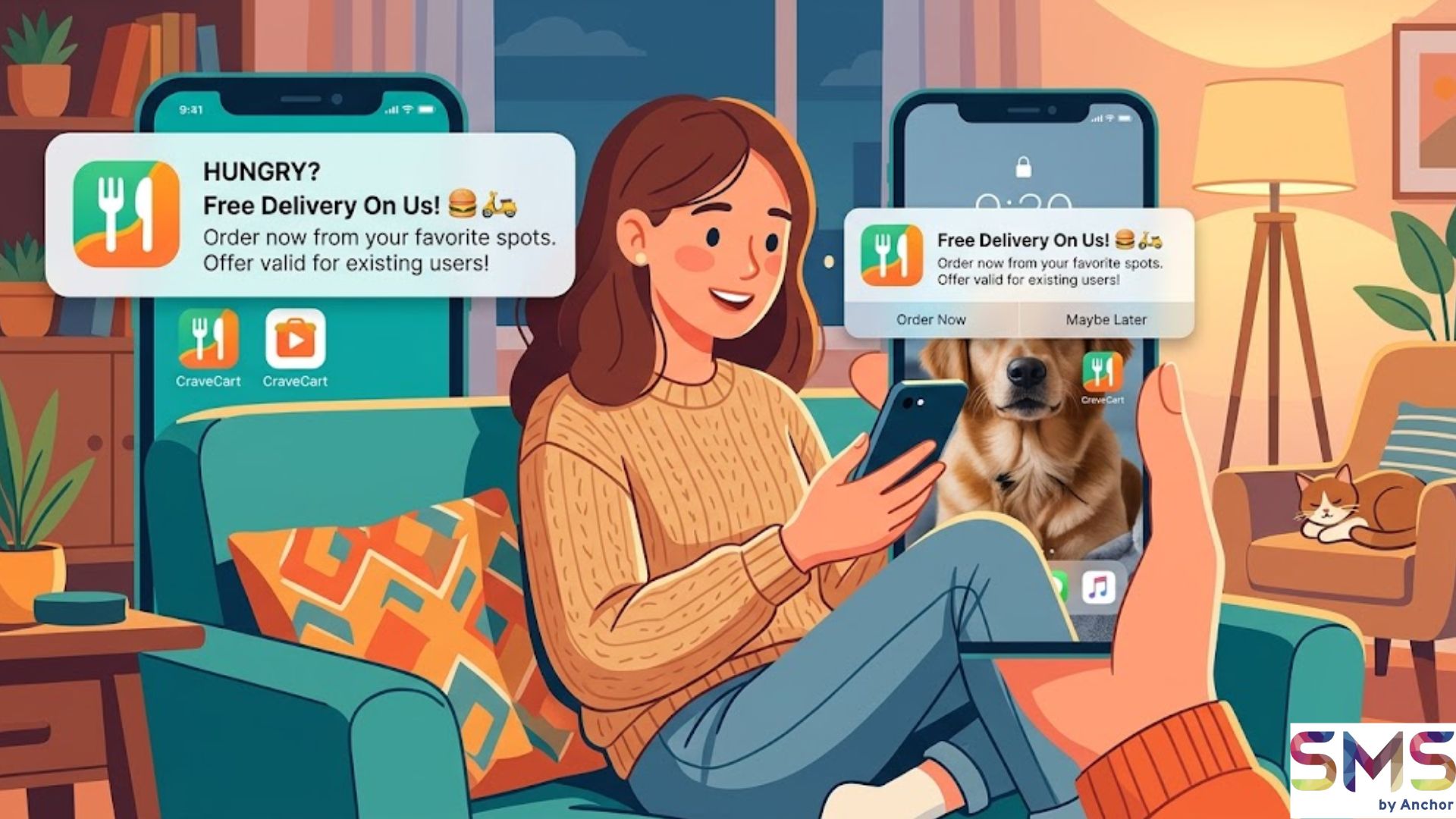
When Should You Use Push Notifications Instead of SMS?
Push notifications work best when your goal is to re-engage existing app users at a lower cost.
Ideal scenarios:
- App engagement reminders
- Feature updates
- Personalised recommendations
- Non-urgent promotions
Example:
A food delivery app sends a push notification offering free delivery. This works because the user already has the app installed.
When is SMS Advertising the Better Choice?
SMS is more effective when reach, urgency, and immediacy matter.
Ideal scenarios:
- Time-sensitive promotions
- OTP and verification messages
- Appointment reminders
- Transactional updates
Example:
A service provider sends an appointment reminder via SMS. The user sees it instantly and takes action.
SMS Customer Segmentation: A Key Advantage
SMS campaigns also benefit from advanced customer segmentation, which helps deliver highly tailored messages. Marketers can segment audiences based on a range of factors like location, purchasing behavior, or engagement history. This means SMS can be used for more personalized, relevant outreach, increasing the chances of conversion.
In contrast, push notifications typically rely on app behavior, but they don’t always have the same level of detailed segmentation as SMS, unless the app specifically collects and uses that data. This makes SMS an even more effective channel for delivering messages that are highly relevant to individual users.
Cost Comparison: Push Notifications vs SMS
Cost is one of the biggest differences between these two channels.
Cost Factor | Push Notifications | SMS |
Setup | App development required | Minimal |
Per message cost | Near zero | Charged per SMS |
Scalability | Very high | Cost increases with volume |
Insight: Push notifications are cheaper at scale, but SMS often delivers better ROI due to higher engagement rates.
CTR and Engagement: Which Performs Better?
SMS generally delivers higher CTR, but push notifications can compete when highly targeted.
Performance comparison:
- SMS CTR: 15–35% (varies by industry)
- Push CTR: 5–15% (depends on app engagement)
What affects both:
- Timing
- Personalisation
- Message clarity
- User intent
Key takeaway: The channel matters less than how relevant the message is.
Can You Use Push Notifications and SMS Together?
Yes. Many companies choose to combine both methods to maximize reach and effectiveness. Push notifications can be used for ongoing engagement within the app, while SMS can handle urgent, time-sensitive communication.
Hybrid strategy example:
- Send push notification first (low cost)
- Follow up with SMS if no response
- Use SMS for urgent reminders
Push Notifications vs SMS: Which Should You Choose?
Both push notifications and SMS play crucial roles in modern marketing strategies.
Push notifications offer cost-efficiency and are perfect for engaging users within your app ecosystem. On the other hand, SMS provides unparalleled reach and immediacy, making it the ideal choice for urgent or high-priority communication.
For a comprehensive messaging strategy, integrating both channels such as SMS marketing, bulk campaigns, and OTP messaging can deliver the best results, ensuring you connect with your audience in the most effective way possible.
Ready to Maximize Your Marketing Impact?
Partner with a reliable SMS service provider today to enhance your reach, boost engagement, and drive conversions. Start your journey with Anchor now!