

Key Takeaways
- Real-time SMS delivery tracking keeps customers informed without requiring apps or logins
- Clear delivery updates reduce missed deliveries and support enquiries
- SMS tracking improves trust by providing consistent, timely communication
- Simple reminder messages are more effective than complex notifications
- Logistics teams can improve communication without increasing operational workload
Most delivery issues are not caused by logistics failures. They are caused by communication gaps.
A parcel may be on time, correctly routed, and out for delivery, but if the customer does not know when it will arrive, the experience still feels unreliable.
This is where many logistics and eCommerce businesses lose trust without realising it.
Real-time delivery tracking via SMS addresses this gap. It provides a direct, structured way to keep customers informed at each stage of the delivery process, without requiring them to check apps, emails, or tracking pages repeatedly.
What is SMS Delivery Tracking?
SMS delivery tracking uses text messages to update customers about their order status, including dispatch, transit progress, and delivery timing, helping improve visibility, reduce uncertainty, and support smoother delivery experiences.
How Does Real-Time Delivery Tracking via SMS Work?
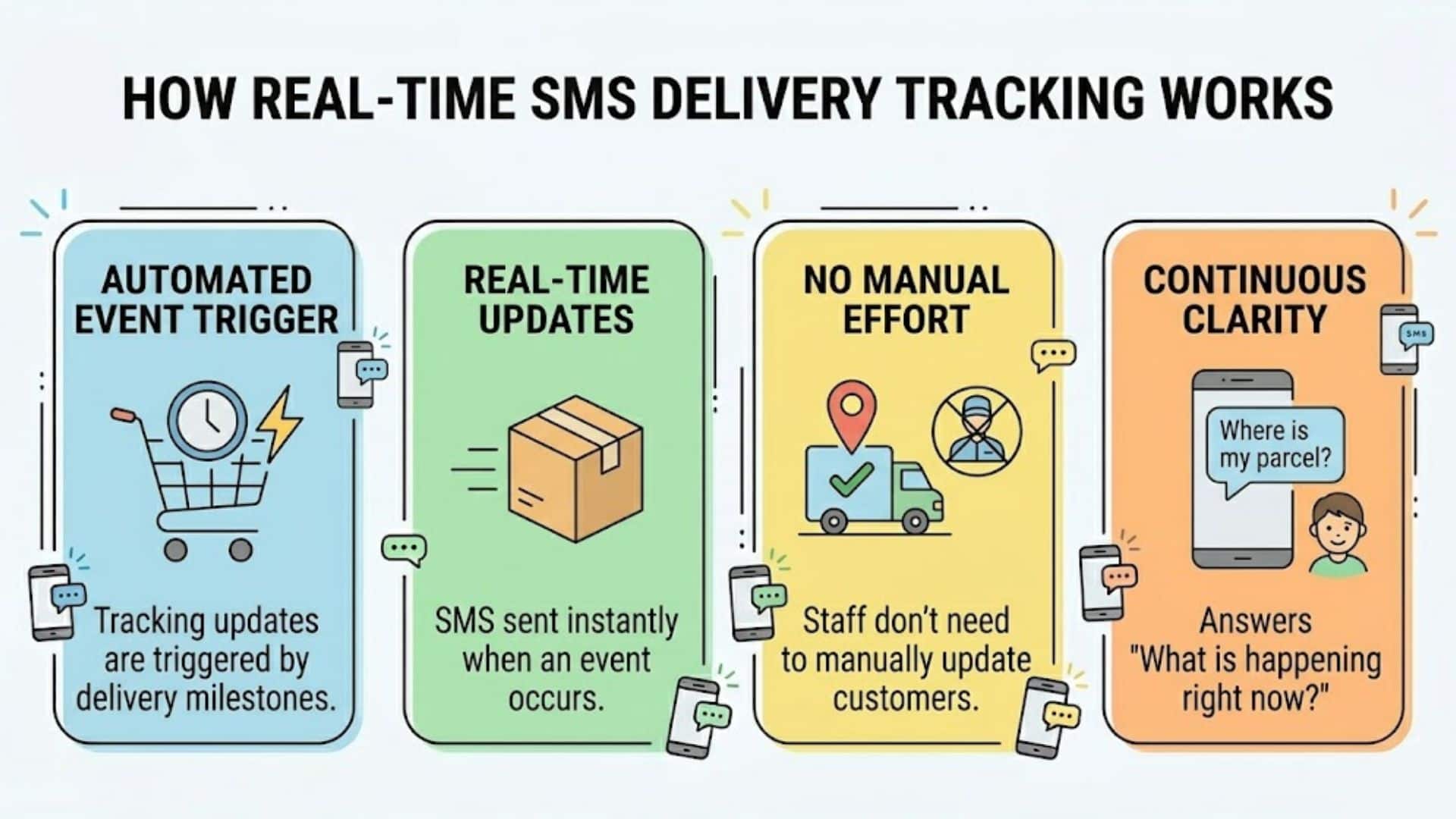
SMS delivery tracking sends automated updates based on delivery events, not manual actions.
Instead of relying on staff to update customers, messages are triggered automatically when key milestones occur.
Typical delivery SMS flow
- Order confirmed
- Parcel dispatched
- Out for delivery
- Delivery rescheduled
Each update answers a simple question for the customer:
“What is happening with my delivery right now?”
For businesses handling multiple orders daily, this type of structured communication is often managed through bulk SMS workflows or automated messaging systems, rather than manual sending.
Why Does SMS Delivery Tracking Improve Customer Trust?
Customers trust businesses that keep them informed, not just those that deliver on time.
A lack of updates creates uncertainty. Customers start checking tracking pages repeatedly or contacting support for confirmation.
What changes with SMS updates
- Customers feel informed without needing to ask
- Fewer “Where is my order?” enquiries
- More predictable delivery expectations
- Less frustration during delays
Real-world scenario: A customer receives an SMS saying their parcel is “out for delivery between 2 PM and 5 PM.” They adjust their schedule accordingly instead of missing the delivery.
This small update often has a larger impact on perceived reliability than the delivery itself.
How Do SMS Updates Reduce Failed Deliveries?
Timely reminder messages help customers prepare, which reduces missed delivery attempts.
Many failed deliveries happen because:
- the customer is not available
- the timing is unclear
- no prior notice was given
How SMS helps reduce this
- Sends a reminder before arrival
- Provides a delivery window
- Allows rescheduling if needed
- Reduces repeat delivery attempts
From an operational perspective, this means fewer redelivery trips and better route efficiency.
What Should a Delivery Tracking SMS Include?
A delivery SMS should prioritise clarity over detail.
Customers are not looking for full tracking logs. They want quick, useful updates. A well-written reminder message should be understood in seconds and guide the next step clearly.
Essential elements
- Order or reference number
- Delivery status
- Estimated delivery time
- Courier or company name
- Action path (tracking or reschedule)
What Do Effective SMS Delivery Messages Look Like?
Effective messages are short, specific, and action-oriented.
Template 1: Order Confirmation
[Company Name] Thank you for your order 73638782. We will notify you when your order is shipped. View your order in App > My Account > Order History.
Template 2: Order Shipped
[Company Name] Your order 73638782 has been shipped. You can track the delivery status in App > My Account > Order History.
Template 3: Out for delivery
[Company Name] Dear Customer, XX Express rider will attempt to deliver your shipment 73638782 today. Do not reply to this SMS. To reschedule, please call XX Express Hotline.
Template 4: Delayed or Special Occasion
[Company Name] We are sorry! There is an unexpected delay in delivering your order 73638782. We are working with our delivery partner to get it to you as soon as possible. View your order in App > My Account > Order History.
Businesses that rely on structured SMS tracking or automated SMS notifications often maintain consistent messaging across all delivery stages and ensure MCMC compliance, which improves clarity and reduces confusion.
How Does SMS Automation Support Logistics Operations?
Automation allows logistics teams to scale communication without increasing workload.
Manually updating customers for every delivery is not practical at scale. Automation removes that bottleneck.
Operational improvements
- Fewer customer service enquiries
- Reduced manual messaging
- More consistent communication
- Better delivery coordination
For businesses handling higher volumes, this is often supported through systems connected to SMS gateways or bulk messaging platforms, which trigger updates automatically based on delivery status.
Does SMS Delivery Tracking Work Better Than App Notifications?
SMS works reliably because it does not depend on user behaviour.
App notifications require:
- app installation
- notifications enabled
- user engagement
SMS avoids these dependencies. It reaches the customer directly, regardless of device or app usage.
This makes it especially useful for logistics businesses serving a broad customer base.
Read more: SMS Advertising Tips That Actually Increase Click Rates
What Common Mistakes Reduce SMS Delivery Effectiveness?
Even a good system can underperform if messages are poorly structured.
Common issues
- Sending too many updates
- Providing vague delivery windows
- Using long or unclear messages
- Not including actionable links
- Delayed or inconsistent updates
Still Relying on Manual Delivery Updates?
If delivery communication depends on manual calls or ad hoc messages, it becomes harder to maintain consistency as order volume grows.
SMS Delivery Tracking for Better Customer Experience
Real-time SMS delivery tracking helps logistics and eCommerce businesses improve communication without adding operational complexity.
It is not just about sending updates. It is about making the delivery experience feel predictable, transparent, and reliable from the customer’s perspective.
Beyond tracking updates, SMS can support a wider range of use cases such as bulk delivery notifications, status alerts, and even OTP SMS for secure delivery verification. These touchpoints help ensure that customers receive timely, consistent information without needing to actively check for updates.
For businesses considering SMS service as part of their logistics communication, the focus should be on using simple, well-timed messages to keep customers informed, reduce uncertainty, and support a more reliable delivery experience.